The genetic legacy of Denisovans may be shaping the modern immune system of southwest Pacific populations
- 8 DEC 2022
- 4:10 PM
- BYANN GIBBON
new infections they would have encountered in the region.
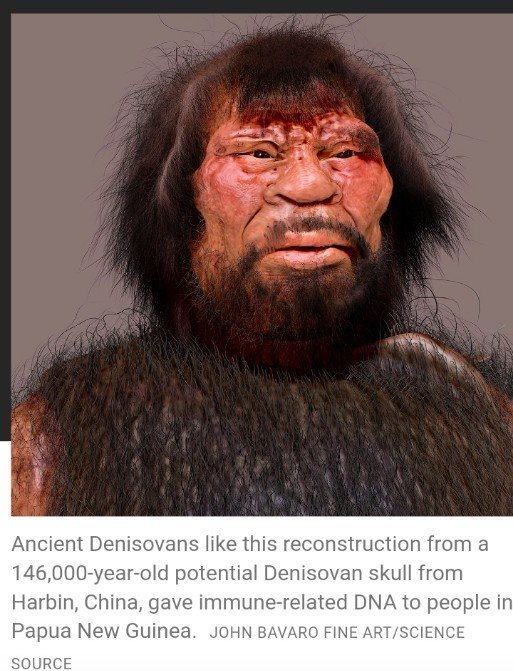
“One of the strengths of the study is that they tested the Denisovan variants in Papuan cell lines, which are essentially the cell environment in which they evolved,” says functional genomicist Francesca Luca of Wayne State University, who was not part of the study.
Taken together, these experiments suggest those Denisovan gene variants “might be fine-tuning the immune response” to optimize it to its environment, says human evolutionary geneticist Irene Gallego Romero of the University of Melbourne, lead author of the new study published in PLOS Genetics. “In the tropics where people have high loads of infectious disease, you might want to tone down the immune response a little and not go overboard.”
These findings dovetail with earlier work on the role of Neanderthal variants in living Europeans. Studies of both Neanderthal and Denisovan DNA in different populations are showing how mating with archaic humans—long-adapted to their regions—provided a rapid way for incoming modern humans to pick up beneficial genes, says computational biologist Janet Kelso of the Max Planck Institute for Evolutionary Anthropology. The study shows this sort of gene swap was “an important mechanism for how humans adapted quickly [to new challenges], specifically pathogens,” says human geneticist Luis Barreiro of the University of Chicago.
But he would like to see future work test whether the Denisovan gene variants actually give Papuans a better shot at warding off or surviving specific diseases.
Overall, this study shows “matings which took place tens of thousands of years ago are still influencing the biology of contemporary individuals,” says population geneticist Joshua Akey of Princeton University.
doi: 10.1126/science.adg2133
 Wantok News